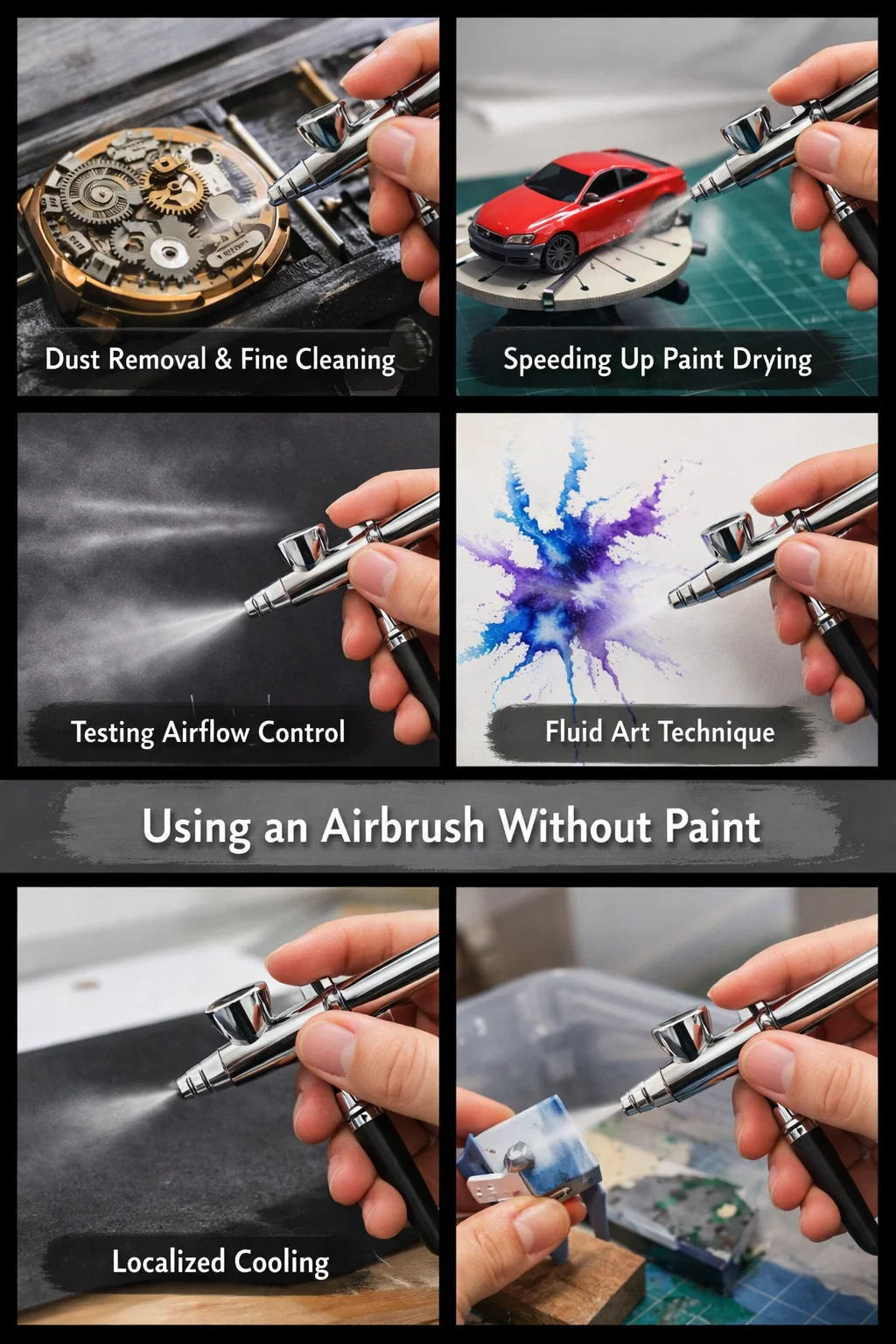
Absolutely! Although the name " airbrush " contains the word "brush," it's essentially a device that allows for precise control of airflow. Even without paint, it remains a very practical and versatile tool.
Here are some common uses of an airbrush without paint:
1. Powerful Dust Removal and Fine Cleaning
This is the most direct "side job" of an airbrush.
Blowing away dust: Its nozzle can emit a very concentrated and powerful stream of air. For dust accumulated in precision models, mechanical watches, camera lenses, or computer keyboard crevices, an airbrush is much cleaner than blowing with your mouth or using a brush, and because it doesn't touch the object, there's no need to worry about scratching the surface.
Cleaning hard-to-reach areas: When doing handicrafts or repairs, you can use it to blow away small debris remaining at the joints of parts.
2. Assisting in Rapid Drying of Paint
If you've just finished a layer of spray painting, or are doing localized coloring with a brush, the airbrush can act as your "miniature hairdryer."
Accelerating dehydration: The pure airflow can carry away surface moisture or solvents, shortening drying time.
Cool air mode: Unlike household hot hairdryers, the airbrush blows out room-temperature air, which is safer for delicate plastic parts that are sensitive to heat and easily deformed.
3. Testing and Understanding Airflow Patterns
For beginners, practicing with an empty airbrush is the best way to learn.
Practicing control: You can feel the relationship between the force of your finger on the trigger and the airflow without wasting paint.
Checking the equipment: Before starting work, a quick empty spray can confirm whether the inside of the airbrush is dry, whether the airflow is stable, and whether the air pump pressure is at the ideal level.
4. Manipulating Fluid Art
There's a special painting technique that doesn't require putting paint into the brush.
Guiding paint flow: You can first drip diluted paint onto the paper, and then use the pure airflow from the airbrush to "push" the paint. By controlling the angle and airflow, you can create effects like branches, marble patterns, or abstract ink splashes. This technique is very popular in modern art.
5. Localized Cooling
Although the effect is limited, a continuous airflow can provide some cooling and curing effect when dealing with small amounts of glue or materials that become sticky due to frictional heat.